
5th Grade Math Project That Your Students Will Love (PBL)
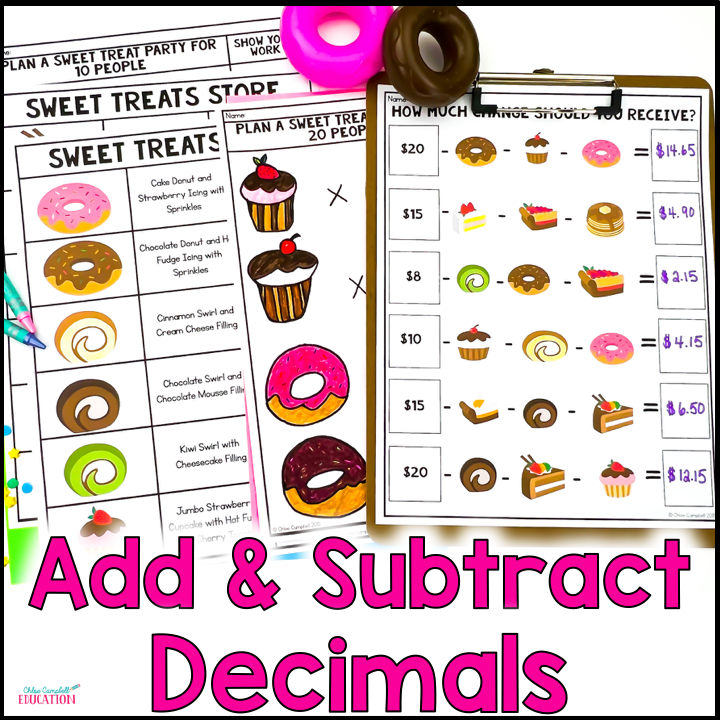
Need a 5th grade math project that doesn’t take three weeks to plan? Have your students plan a sweet treat party.
They get a dessert menu and a budget. Then they add and subtract decimals to build a party they can actually afford. I taught 3rd to 5th grade math for 13 years, so I built this one to be easy to run on a real school day.
Run it in one class period, or stretch it over a few days. It works any time of year.
➡️ See the Sweet Treat Party project inside the Sneaky Learning Club
Quick answer: A good 5th grade math project gives students a real reason to use grade-level math. In the Sweet Treat Party project, students pick desserts from a menu, add up decimal prices, subtract from a set budget and adjust until their party fits. It covers adding and subtracting decimals to hundredths (5.NBT.B.7), estimation and problem solving in one activity.
Learn more about my teaching approach here.
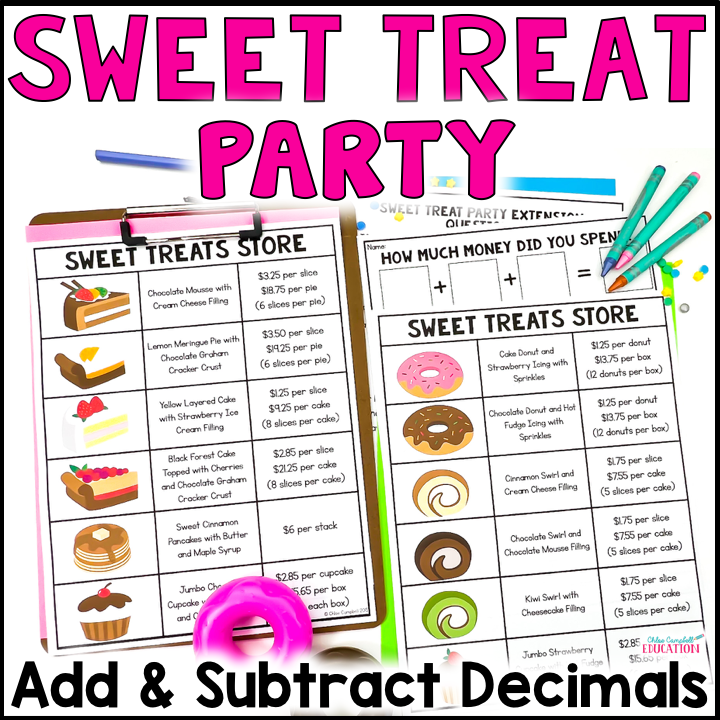
The Benefits of Using a 5th Grade Math Project
I love projects because they let students use skills from across the grade level in a real way.
This one is extra fun because of the dessert theme and the visuals.
Here’s a closer look at the core concepts they’ll be practicing through this activity:
Adding and Subtracting Decimals
Adding and subtracting decimals is at the heart of this project.
Students choose items from a dessert menu, total up their choices, and adjust based on their party budget.
This repetitive, real-world practice strengthens their decimal operation skills in a way that feels more natural than traditional worksheets, as they actively engage with the numbers in a meaningful way.
Budgeting Basics
In planning a party, students are introduced to the idea of budgeting.
They’ll work within a set budget, selecting items they can afford and seeing how each choice affects their remaining balance.
Budgeting helps students grasp the practical side of decimal addition and subtraction, showing them how math applies to everyday situations like shopping and event planning.
Mental Math and Estimation
While working with decimals, students will often estimate costs to see if an item fits within their budget before calculating exact totals.
This mental math component teaches them to round, make quick decisions, and improve their estimation skills, which are crucial for more advanced math.
They’re learning to look at numbers flexibly, understanding when exact calculations are needed and when an estimate will do.
Problem-Solving and Decision-Making
The project also requires students to make choices based on their budget and the number of items they want.
This encourages problem-solving as they weigh options and adjust selections.
For example, if they want a specific number of desserts for a large party, they may need to choose smaller items or stay within the limits of a lower-priced category.
Decision-making like this builds critical thinking skills and helps students learn how to manage resources effectively.
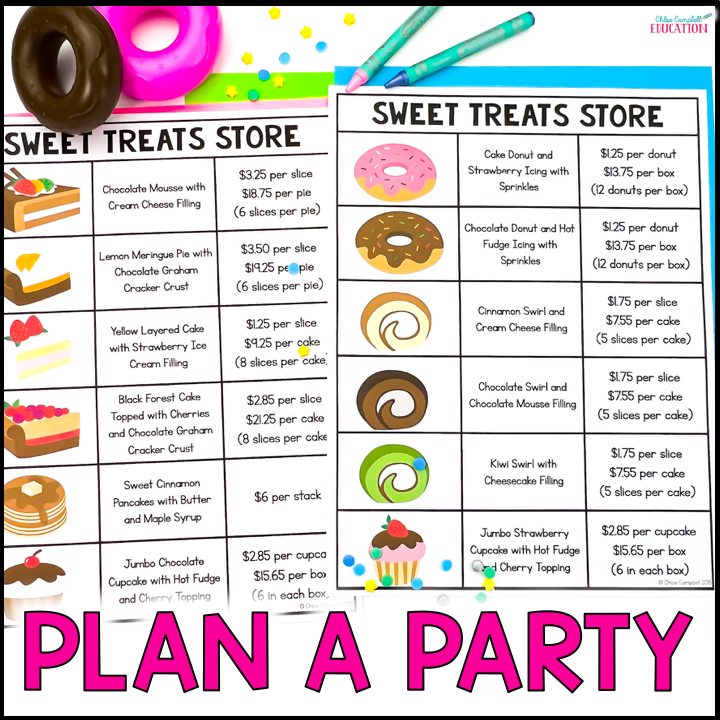
How to run the Sweet Treat Party project
- Give each student (or group) a budget, like $25.00.
- Hand out the dessert menu and have them estimate first. Will three items fit?
- They add the exact prices, lining up the decimal points.
- They subtract the total from the budget to see what’s left.
- If they went over, they swap an item and try again.
Here’s what that looks like with example numbers. A student has $25.00. She picks cupcakes for $12.75 and cookies for $6.50.
12.75 + 6.50 = 19.25
25.00 minus 19.25 leaves 5.75. Can she add lemonade for $4.99? 5.75 minus 4.99 = 0.76. Yes, with 76 cents to spare.
Need to teach the skill before the project? Here are my tips for teaching adding and subtracting decimals.
Fun Ways to Incorporate Project Based Learning With Party Planning
The theme of this project naturally lends itself to fun ideas!
Here are some that you can try:
Create a “Classroom Sweet Treat Store”
Print the dessert menu on large paper or posters and place it around the room, transforming the classroom into a mini “store.”
This setup allows students to move around and “shop” for their treats, adding an interactive element that keeps their energy focused.
You could also set up smaller “stores” at different stations where students calculate costs for different party scenarios.
Set Up Small Group or Partner Shopping Trips
Pair students up or put them in small groups, allowing them to work together to plan their dessert party. In addition to practicing decimal math, students will develop teamwork and communication skills.
They’ll discuss their options, decide which items to purchase, and share the job of totaling costs. And they have to stay on budget the whole time.
Individual Choice with Differentiation
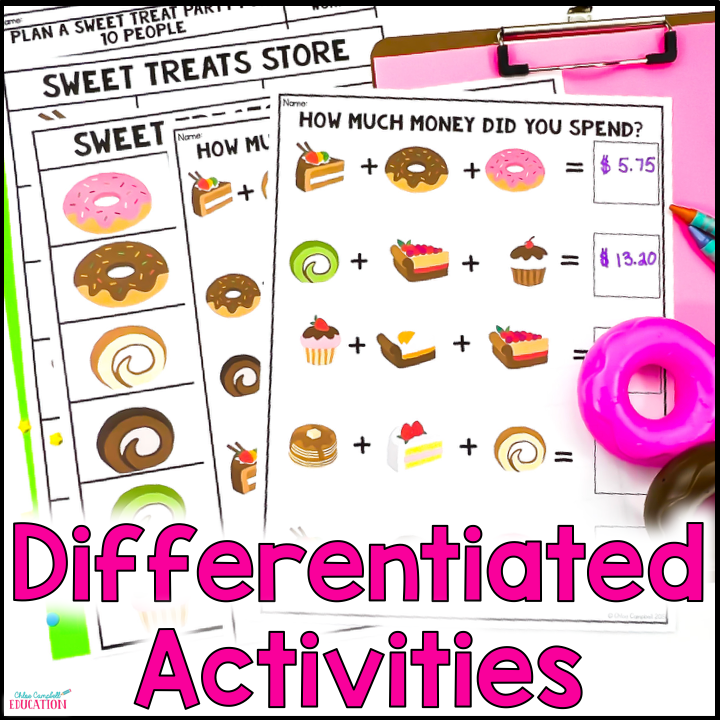
If you want students to work individually, provide different leveled worksheets where they can plan a party for a certain number of people or select a specified number of treats.
This is great for differentiation because you can adjust the difficulty based on the student’s comfort level with decimals.
For example, some students might be asked to calculate the cost for three items, while others might budget for a larger group.
Ideas to Make Project Based Learning (PBL) More Doable
Outside of having the resources and knowing how to facilitate it, time management is always a challenge.
So in this section, I’m sharing practical tips to help you make this 5th grade math project happen!
- Weekly Review with Budget Challenges
Once a week, dedicate one class period to a budget “challenge” using the project materials. For example, give students a set amount of “party money” and specific constraints on items they can buy. This variation keeps adding and subtracting decimals fresh and introduces real-time decision-making, which is valuable for keeping students focused without traditional drills. - Small Group Review Sessions
Divide the class into small groups and give each group a budget scenario to work through together. By discussing and solving each budget scenario collaboratively, students get extra practice adding and subtracting decimals, and you save time by reviewing multiple concepts in one activity. Each group’s solution can then be presented, letting the class discuss different budgeting approaches and verify calculations. - Personal Goal-Setting
Encourage students to set individual goals based on their comfort level with decimals. Some may aim to master adding items up to $10, while others might aim to complete more complex budgets or add larger quantities of items. Having personal goals helps each student focus on their growth areas, making the project feel like a fun way to meet personal milestones rather than just a test prep assignment. - Practice “Quick Check” Skills
Give students quick, timed exercises within the project, like adding up three or four items from the menu within a couple of minutes. This timed practice helps with mental math and confidence, preparing them for the pace of timed tests. By practicing in short bursts, students improve their accuracy with decimals without feeling overwhelmed by longer review sessions. - Reflective Math Journals
After each practice session, ask students to write a short reflection on what they learned about budgeting or adding and subtracting decimals. This reflection can be as simple as jotting down one area they feel confident in and one they’d like to improve. Reflection helps students internalize what they’ve practiced and lets you assess their understanding without extra test prep materials.
Decimal mistakes to watch for
- Lining up the last digits instead of the decimal points. 12.75 + 6.5 written right-aligned turns into 13.40. Have students write 6.5 as 6.50 first.
- Subtracting from a whole-dollar budget. 25 minus 19.25 trips kids up. Writing it as 25.00 makes the regrouping clear.
- Skipping the estimate. If they round first ($13 + $7 = about $20), a total of $13.40 jumps out as wrong.
Want to grade the project? It works well as a summative assessment. Here are 15 summative assessment examples for more ideas. Running it as a station? See getting started with 5th grade math stations.
Get the Sweet Treat Party project
The Sweet Treat Party project is inside the Sneaky Learning Club, my math activity membership for 3rd to 5th grade. Every activity is tied to a standard and ready to print, so you’re not building projects from scratch at 9pm.
Not ready to join? Grab my free math games sample pack and try one this week. When your class is ready for the next decimal skill, here’s how to teach multiplying decimals.
Frequently Asked Questions
One where students use grade-level math to make real decisions. Planning a party on a budget works well because it takes adding and subtracting decimals, estimating and checking work, and students care how it turns out.
You can run it in a single class period for one party plan. Or spread it over a few days with the classroom store, group shopping trips and a reflection.
Mainly 5.NBT.B.7, adding and subtracting decimals to hundredths. Students also round and estimate to check whether items fit the budget.
Change the budget, the number of guests or the number of items. Some students total three items while others budget for a bigger party.
Yes. Have students show their totals and their remaining budget, and you’ll see who can add and subtract decimals accurately on their own.
Pick a budget, print a menu and let them shop tomorrow.





 10 Science Activities: Science Experiments
 No Prep Emergency Sub Plans for 4th & 5th Grade - All About Sharks - 5 Full Days